Qazvin
Qazvin
Iran's forgotten Safavid capital and the gateway to the Assassins' valley
 8 highlights · tap a pin
Qazvin was the capital of Safavid Persia from 1555 to 1598 under Shah Tahmasp I, before Shah Abbas moved the seat of power to Isfahan, and the city still carries that royal imprint in its surviving palace pavilion, monumental gate and Iran's first planned avenue. A deeply historic settlement with Sasanian roots and one of Iran's oldest congregational mosques, it is also a celebrated city of calligraphy, baklava and traditional flood-spreading gardens (baghestan). Today most travellers know it as the launch point for the Alamut valley, the mountain stronghold of Hassan-i Sabbah's Nizari Ismaili "Assassins."
Next 5 days
Top places to see
- 1
Sa'd al-Saltaneh Caravanserai
UNESCO 2023Vast, beautifully restored Qajar-era urban caravanserai and covered bazaar, now UNESCO-listed. One of Iran's best-preserved and largest indoor (urban) caravanserais (~2.6 ha core; cited up to 6.2 ha). Inscribed in 2023 as part of UNESCO's serial 'The Persian Caravanserai'. Its tiled crossroads (chahar-suq) dome is the architectural highlight; now full of cafes, craft shops and galleries.
- Where
- Old city, near the Grand Bazaar
- Time needed
- 1-2 hours
- Opening hours
- Parts still under restoration; shop/cafe hours vary - verify before travel.
- 2
Chehel Sotoun Pavilion (Kolah Farangi / Qazvin Calligraphy Museum)
Octagonal two-storey Safavid garden pavilion, the main survivor of the royal complex, housing the calligraphy museum. Built under the Safavids (Shah Tahmasp era, later remodeled in Qajar times) in the Sabze Meydan / Azadi Square garden; its first-floor murals are famed examples of the Qazvin miniature school. Now the city's calligraphy museum, displaying historic manuscripts and calligraphy.
- Where
- Azadi Square / Sabze Meydan
- Time needed
- 45-60 minutes
- Opening hours
- Museum hours and ticket price change seasonally - verify before travel.
- 3
Alamut Castle (Hassan-i Sabbah's fortress)
Ruined 'Eagle's Nest' mountaintop fortress of the medieval Nizari Ismaili 'Assassins', ~100 km from the city. Seized by Hassan-i Sabbah in 1090 and capital of the Nizari Ismaili state until its 1256 Mongol fall. Perched on a ~2,100 m crag above Gazor Khan village in a spectacular Alborz valley; the inspiration behind the 'Assassin's Creed' legend. Combine with the Alamut/Ovan lake scenery.
- Where
- Alamut valley, near Gazor Khan (Qazvin province)
- Time needed
- Full-day trip from Qazvin
- Opening hours
- Day-trip from Qazvin; steep final climb on foot. Roads can close with snow in winter - verify access before travel.
- 4
Jameh (Atiq) Mosque of Qazvin
One of Iran's oldest congregational mosques, with a Seljuk dome chamber over an early-Islamic core. Founding tradition reaches back to c. 807 CE on a possible Sasanian fire-temple site; the southern dome chamber and its Kufic inscriptions date to the Seljuk period (c. 1106-1114). A textbook of Iranian mosque evolution across many dynasties.
- Where
- Old city, off Sepah Street
- Time needed
- 30-45 minutes
- Opening hours
- Active mosque - dress modestly; avoid prayer times for sightseeing. Verify visiting hours before travel.
- 5
Aminiha Hosseiniyeh
Ornate Qajar-era mansion and mourning hall famed for mirror work, Orsi stained-glass windows and painted ceilings. Built in the 19th century (c. 1858) for the wealthy Amini family, it is one of Qazvin's most beautiful interiors - single-piece carpets, muqarnas, mirror halls and colored-glass Orsi windows that cast patterns across the floors.
- Where
- Molavi / old residential quarter
- Time needed
- 30-45 minutes
- Opening hours
- Privately significant historic house; hours limited - verify before travel.
- 6
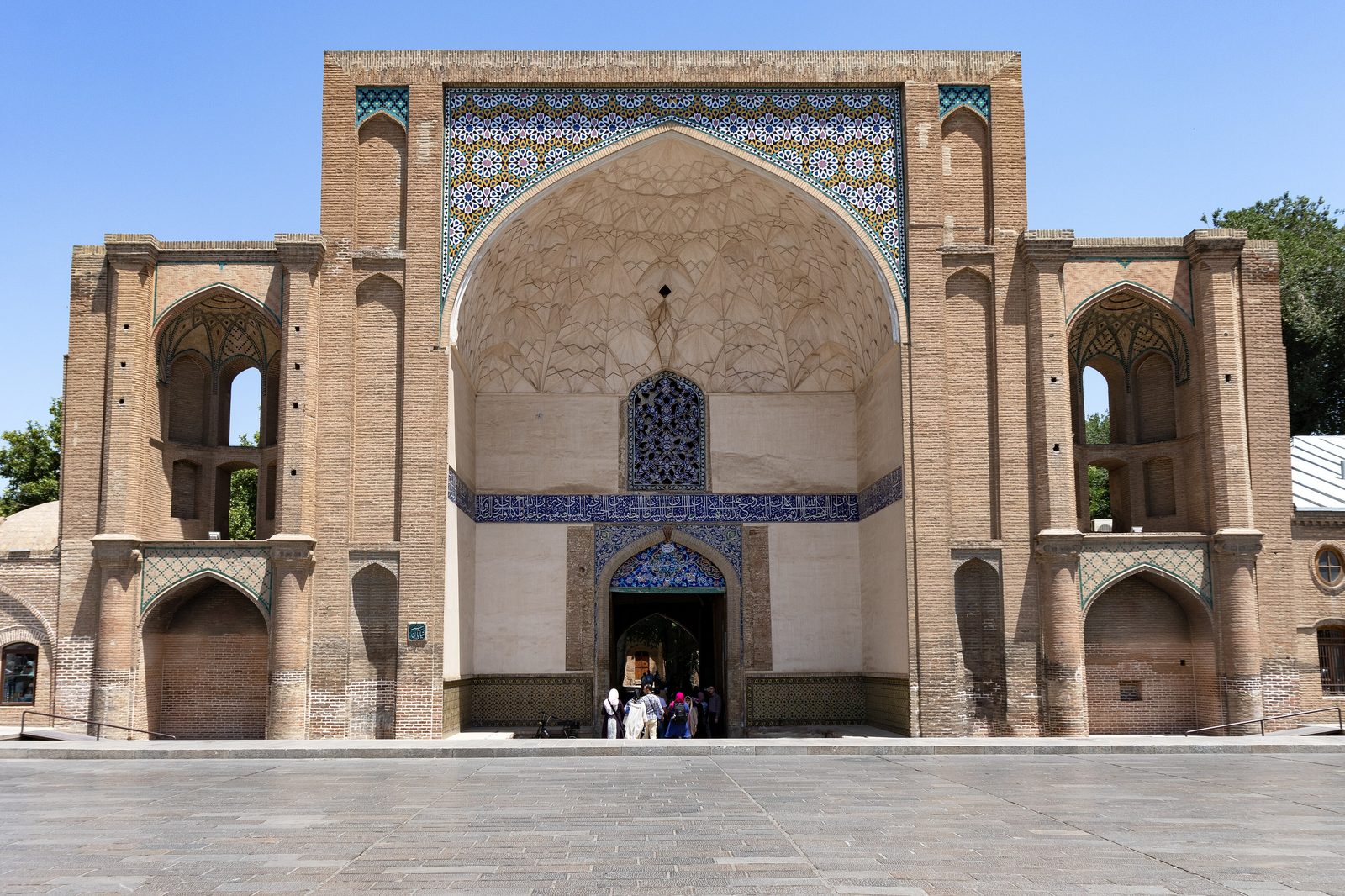
Ali Qapu Gate (Aali Qapu)
Surviving monumental portal of the Safavid Government House, with fine tilework. Along with Chehel Sotoun, the only standing remnant of Shah Tahmasp's Safavid royal precinct; it was the principal southern gateway to the palace complex. A symbol of Qazvin's brief reign as Iran's capital.
- Where
- Azadi Square area
- Time needed
- 15-20 minutes
- Opening hours
- Exact coords approximate (near Chehel Sotoun garden) - verify on the ground.
- 7
Peyghambarieh Shrine (Tomb of the Four Prophets)
Blue-domed shrine complex venerating four pre-Islamic Jewish prophets, with mosque and madrasa. A revered pilgrimage site said to hold the tombs of four prophets who foretold the coming of Christ; the present richly tiled buildings were largely completed c. 1913-1914. A rare shrine linking Iranian, Jewish and Christian traditions.
- Where
- Peyghambarieh Street, old city
- Time needed
- 30 minutes
- Opening hours
- Active shrine - modest dress and headscarf required for women. Verify visiting access for non-Muslims before travel.
- 8
Heydarieh (Heidarieh) Mosque & Madrasa
Seljuk-era mosque-madrasa noted for its delicate stucco mihrab and Kufic inscriptions. Founded on an early-Islamic / possibly pre-Islamic site, the surviving Seljuk dome chamber (12th c.) preserves some of the finest early stucco decoration and inscription bands in northern Iran.
- Where
- Old city
- Time needed
- 20-30 minutes
- Opening hours
- Hours limited; sometimes locked - ask locally. Verify before travel.
- 9
Sepah Street (Sabze Meydan axis)
Said to be Iran's first planned/modern street, laid out in the Safavid period. Created in the 16th century as the ceremonial avenue leading to the Safavid royal complex, it is widely cited as Iran's oldest planned street; pleasant for a stroll past the Jameh Mosque, Imamzadeh Hossein and old shopfronts.
- Where
- City spine from Azadi Square
- Time needed
- 30-60 minutes walking
- Opening hours
- Public street - always open; coords approximate.
- 10
Imamzadeh Hossein Shrine (Shahzadeh Hossein)
Important Safavid-founded shrine with a gilded dome and mirror-worked sanctuary. One of Qazvin's holiest shrines, traditionally the tomb of an infant son of Imam Reza; expanded under the Safavids and Qajars with lavish tile, mirror and silverwork.
- Where
- Imamzadeh / old city
- Time needed
- 30 minutes
- Opening hours
- Active pilgrimage site - strict modest dress; coords approximate. Verify access before travel.
Where to stay in Qazvin
From $4 a night, our service included