Fars
Persepolis
The ceremonial heart of the Achaemenid Empire, carved in stone.
 8 highlights · tap a pin
Persepolis (Old Persian Parsa, locally Takht-e Jamshid, "Throne of Jamshid") was the ceremonial capital of the Achaemenid Empire, begun by Darius I around 515 BC on a vast stone terrace at the foot of the Kuh-e Rahmat in the Marvdasht plain of Fars. Successive kings — Xerxes I and Artaxerxes I — added monumental palaces, audience halls and gateways whose bas-reliefs depict tribute-bearing delegations from 23 subject nations of the empire. The complex was looted and burned by Alexander the Great in 330 BC, ending its role as imperial showpiece, but its colossal columns, sculpted stairways and gateway lamassu remain among the most complete surviving statements of ancient Persian art and power. Inscribed on the UNESCO World Heritage List in 1979, it lies about 60 km northeast of Shiraz near the town of Marvdasht.
Next 5 days
Top places to see
 1
1Apadana Palace
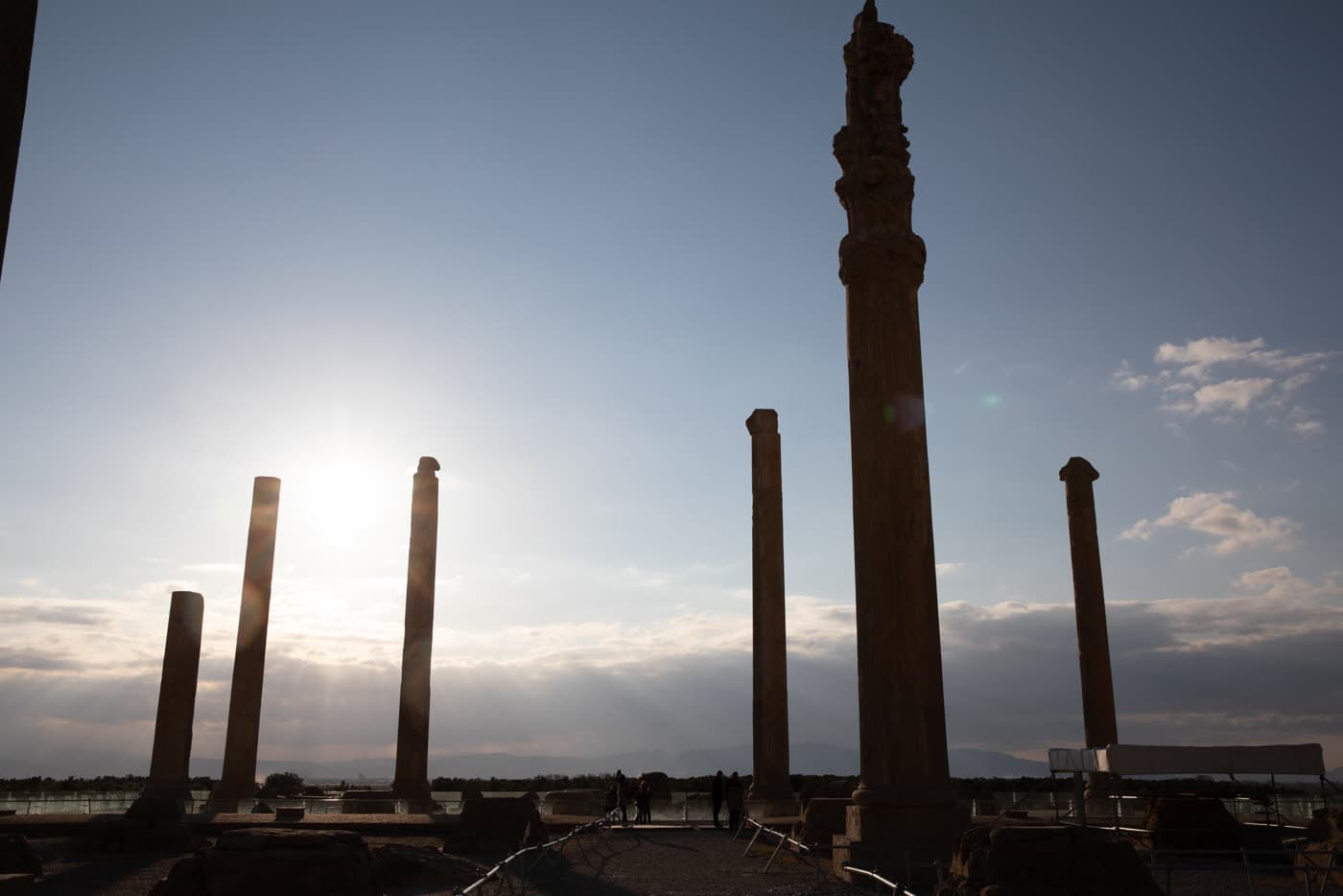
Darius I's grand audience hall, famed for its tribute-bearer stairway reliefs. The largest and most celebrated structure on the terrace; its eastern and northern stairways carry the iconic procession of 23 delegations bearing gifts to the king, the single most important sculptural program at Persepolis. Of 72 original 20m columns, around 13 still stand.
- Where
- Persepolis terrace
- Time needed
- 45-60 min
- Opening hours
- Site open daily roughly 8:00 to sunset; hours and ticket price vary seasonally - verify before travel.
 2
2Gate of All Nations (Gate of Xerxes)
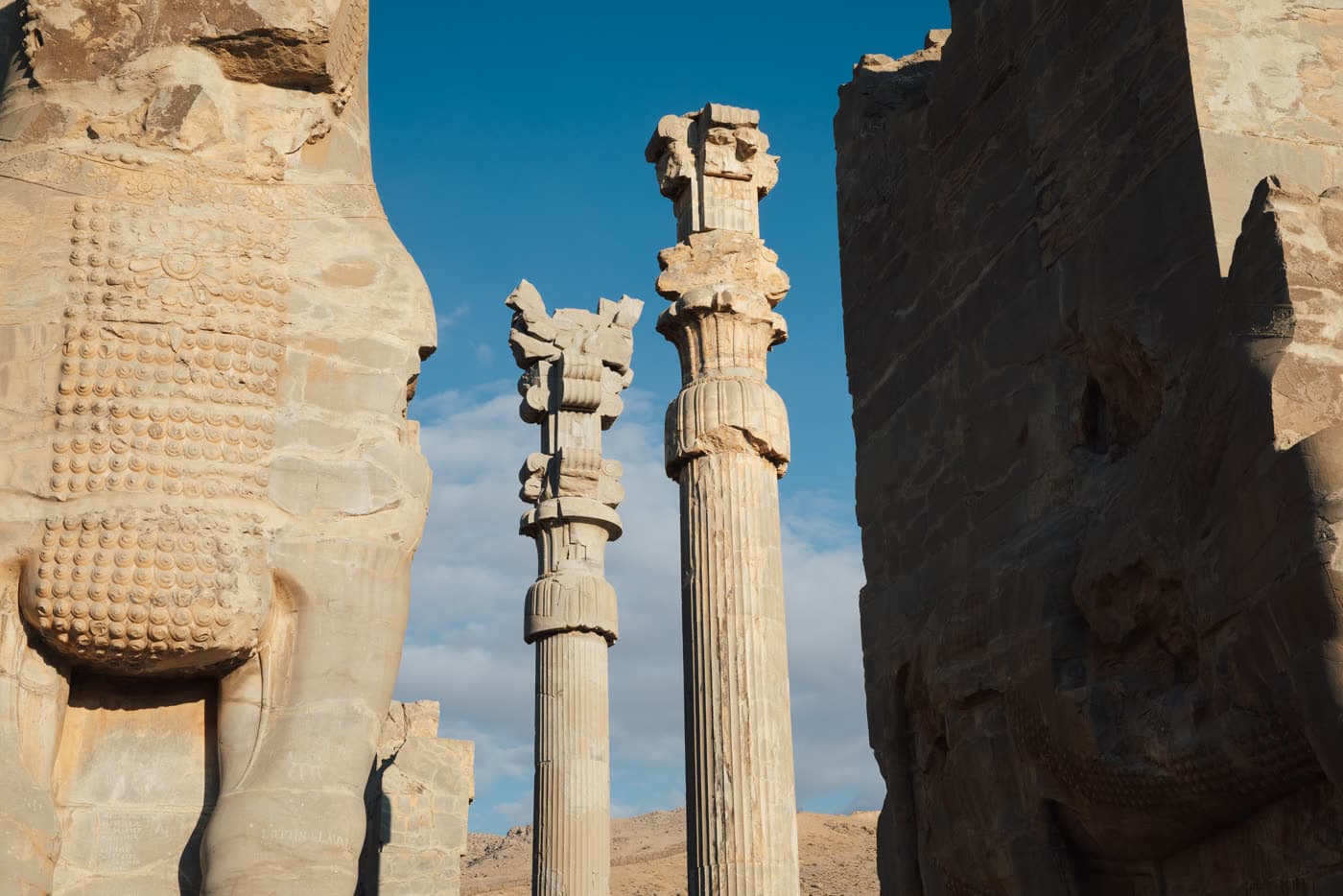
Xerxes I's grand entrance guarded by colossal human-headed winged bull lamassu. The ceremonial threshold to the terrace, a roughly 25m-square hall whose surviving lamassu (double-bull and man-headed bull capitals) and trilingual cuneiform inscription of Xerxes greet every visitor. The defining first image of Persepolis.
- Where
- Persepolis terrace (north)
- Time needed
- 20-30 min
- Opening hours
- Verify hours before travel.
- 3
Throne Hall (Hall of a Hundred Columns)
Vast 70m-square hall begun by Xerxes I and completed by Artaxerxes I. The second-largest building on the terrace, originally roofed by 100 columns; its doorway reliefs show the enthroned king and royal combat scenes. Used for receptions and later as a storehouse before its destruction.
- Where
- Persepolis terrace (east)
- Time needed
- 20-30 min
- Opening hours
- Verify hours before travel.
- 4
Tachara (Palace of Darius)
Darius the Great's private palace, the best-preserved building at Persepolis. The oldest and most intact structure on the terrace, with finely polished black stone doorframes and some of the sharpest surviving reliefs, including servant and royal-attendant figures. Known as the 'Hall of Mirrors' for its once-glossy stone.
- Where
- Persepolis terrace (south)
- Time needed
- 20-30 min
- Opening hours
- Verify hours before travel.
- 5
Hadish (Palace of Xerxes)
Xerxes I's residential palace on the highest part of the terrace. One of the largest residential palaces, occupying the terrace's highest level with commanding views; its doorway reliefs echo those of the Tachara and it was heavily affected by the 330 BC fire.
- Where
- Persepolis terrace (south)
- Time needed
- 15-20 min
- Opening hours
- Verify hours before travel.
- 6
Tripylon (Central / Council Hall)
Small central audience hall linking the main palaces. A pivotal connecting structure near the terrace's center, its stairway reliefs show Persian and Median nobles ascending — a key example of the procession motif at smaller scale.
- Where
- Persepolis terrace (center)
- Time needed
- 10-15 min
- Opening hours
- Verify hours before travel.
- 7
Rock-cut Royal Tombs above the terrace
Cliff tombs of later Achaemenid kings (likely Artaxerxes II and III) carved into Kuh-e Rahmat. Cruciform facade tombs cut into the mountain directly behind the complex, mirroring the royal necropolis at Naqsh-e Rostam and offering the best elevated panorama over the whole terrace.
- Where
- Kuh-e Rahmat hillside (east of terrace)
- Time needed
- 20-30 min
- Opening hours
- Short uphill walk; verify access before travel.
- 8
Naqsh-e Rostam
Achaemenid royal necropolis with four cliff tombs and major Sassanid rock reliefs, ~6 km from Persepolis. The cross-shaped tombs of Darius I, Xerxes I, Artaxerxes I and Darius II are cut high into the cliff, beneath them a series of monumental Sasanian victory reliefs and the enigmatic Ka'ba-ye Zartosht tower. The single most important sight to pair with Persepolis.
- Where
- Marvdasht plain (~6 km north of Persepolis)
- Time needed
- 45-60 min
- Opening hours
- Separate ticket; verify hours and combined-ticket options before travel.
- 9
Naqsh-e Rajab
Compact group of early Sassanid rock reliefs, ~3 km from Persepolis. Four well-preserved Sasanian bas-reliefs (investiture of Ardashir I, equestrian scenes) plus the inscription of the priest Kartir, an easy and uncrowded add-on between Persepolis and Naqsh-e Rostam.
- Where
- Marvdasht plain (~3 km north of Persepolis)
- Time needed
- 20-30 min
- Opening hours
- Verify hours before travel.
- 10
Pasargadae & Tomb of Cyrus the Great
UNESCO 2004First Achaemenid capital and the austere stepped tomb of Cyrus the Great, ~60 km north (separate UNESCO site, 2004). Founded by Cyrus the Great, the original Achaemenid capital predates Persepolis; its simple six-stepped limestone tomb of Cyrus is one of Iran's most revered monuments and a UNESCO World Heritage Site in its own right.
- Where
- Pasargadae plain (~60 km north of Persepolis)
- Time needed
- 1-1.5 hr
- Opening hours
- Roughly 1 hr drive each way; separate ticket - verify hours before travel.