Fars
Pasargadae
First capital of Cyrus the Great, where the Persian Empire began
 8 highlights · tap a pin
Pasargadae was the first dynastic capital of the Achaemenid Empire, founded by Cyrus II (the Great) in the 6th century BC on the plain of Pars, the Persian homeland. The 160-hectare archaeological site preserves the austere limestone Tomb of Cyrus, the ruins of his palaces and audience hall, a fortified citadel (Tall-e Takht), and the remains of the world's earliest recorded fourfold "chahar bagh" garden, all reflecting an unprecedented synthesis of Elamite, Babylonian, Assyrian, Egyptian and Anatolian artistic traditions. Inscribed by UNESCO in 2004, it lies about 90-130 km northeast of Shiraz and roughly 40 km north of Persepolis, the later capital that succeeded it under Darius the Great.
Next 5 days
Top places to see
- 1
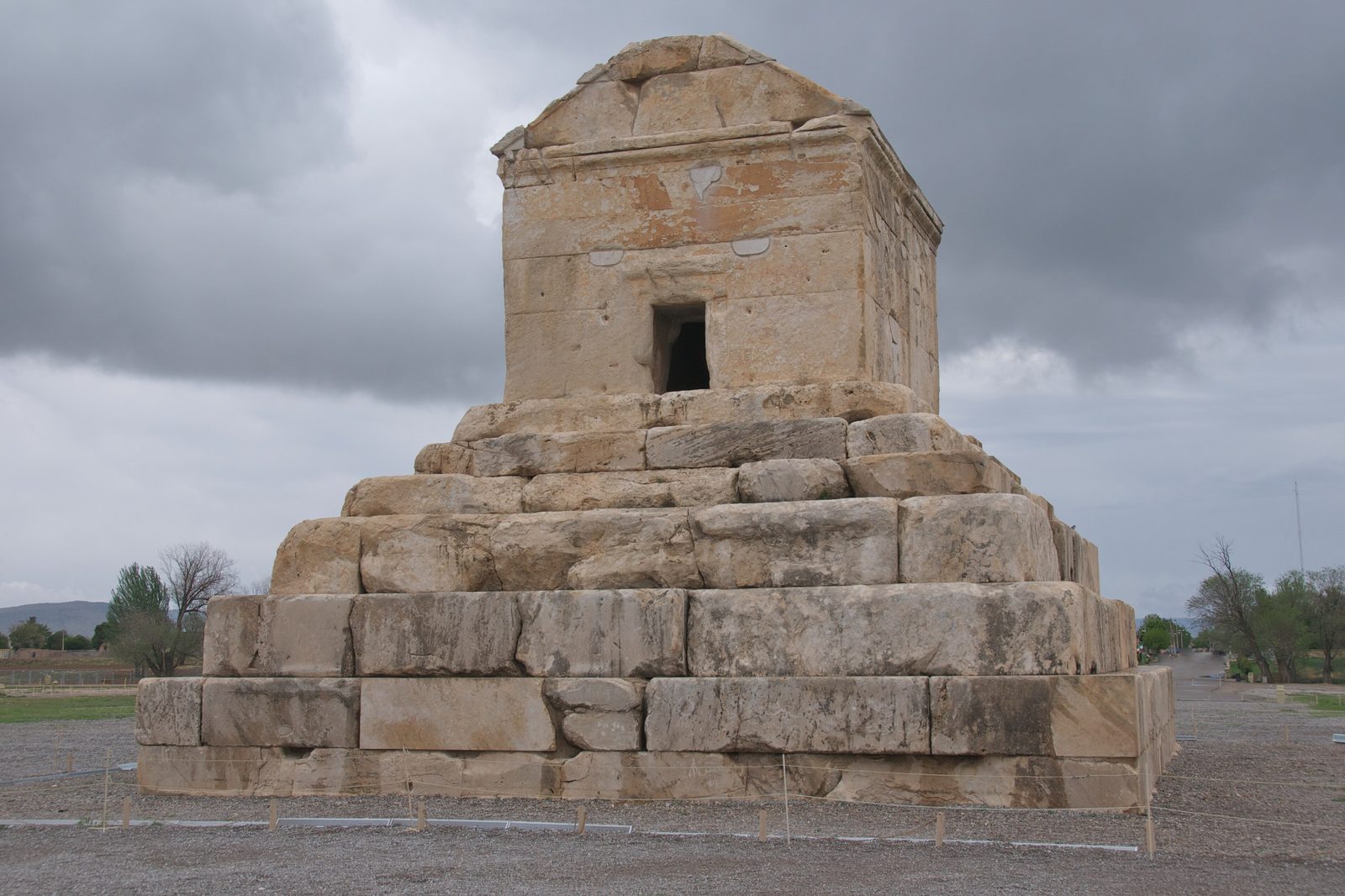
Tomb of Cyrus the Great
Austere stepped limestone mausoleum of the empire's founder, the site's defining monument. A gabled stone burial chamber set atop a six-tier stepped plinth, standing a little over 11 m tall. Its restrained, perfectly proportioned design fuses Mesopotamian/Elamite ziggurat form with Urartian and Lydian/Ionian detail. Alexander the Great paid his respects here; it remains one of the most revered monuments in Iran.
- Time needed
- 30-45 min
- Opening hours
- Within the fenced archaeological park; standard daytime hours and a single site ticket usually cover all monuments - verify hours and price before travel.
- 2
Tall-e Takht (Throne of the Mother of Solomon / Citadel)
Massive fortified terrace and citadel on a natural hill above the plain. The administrative and defensive stronghold of Pasargadae, begun under Cyrus with finely cut, mortarless Lydian-style ashlar masonry and continued in mud-brick under Darius. Its huge stone platform and commanding views illustrate Achaemenid engineering and fortification.
- Time needed
- 30-40 min
- Opening hours
- Reached by a short uphill walk from the main palace area; verify access before travel.
- 3
Palace S (Audience Hall / Apadana)
Ruins of Cyrus's columned audience hall, ancestor of the great Persepolis apadanas. Once a hypostyle hall of tall columns; a single column and column bases survive along with carved doorjamb reliefs. It pioneered the columned-hall plan that defined later Achaemenid palace architecture.
- Time needed
- 20-30 min
- Opening hours
- On the central palace plain; verify before travel.
- 4
Palace P (Residential Palace)
Remains of Cyrus's private residential palace with surviving portico and reliefs. Featured a long columned portico and is the palace bearing trilingual cuneiform inscriptions naming 'Cyrus the King, an Achaemenid.' It overlooked the formal royal garden, integrating architecture and landscape.
- Time needed
- 20-30 min
- Opening hours
- Adjacent to the royal garden remains; verify before travel.
- 5
Gate R and the Winged Figure relief
Remains of the monumental gatehouse holding the famous four-winged guardian relief. Considered among the oldest known freestanding gatehouses (propylaea). Its surviving doorjamb bears a ~2.5 m four-winged figure crowned with an Egyptian-style Hemhem crown - an Elamite robe, Egyptian crown, Assyrian/Syro-Phoenician wings and Ionian rosette border, the empire's multicultural imagery in one image. Once carried (now lost) the inscription 'I, Cyrus, the King, an Achaemenid.'
- Time needed
- 15-20 min
- Opening hours
- On the eastern edge of the palace area; verify before travel.
- 6
Royal Garden (Chahar Bagh) and water channels
Earthwork and stone channels of the world's earliest recorded fourfold Persian garden. Cyrus laid out a geometric, quartered garden fed by precisely cut limestone water channels and basins - the prototype of the Persian 'chahar bagh' that influenced garden design from the Taj Mahal to European parks. The stone watercourses and pavilion bases are still traceable on the ground.
- Time needed
- 15-20 min
- Opening hours
- Best seen as low remains between Palaces P and S; verify before travel.
- 7
Zendan-e Soleiman (Prison of Solomon)
Tall, ruined square stone tower of uncertain purpose near the palace zone. A single surviving wall of a tower-like structure closely resembling the better-preserved Kaaba-ye Zartosht at Naqsh-e Rostam. Its function - tomb, fire temple or ceremonial repository - remains debated, adding to the site's mystery.
- Time needed
- 10-15 min
- Opening hours
- Within the archaeological park; verify access before travel.
- 8
Sacred Precinct and fire altars
Two stone plinths on a hillside thought to be open-air ceremonial/fire altars. A pair of carved stone platforms (one with steps) interpreted as an Achaemenid open-air ritual area, possibly where royal investiture or fire ceremonies took place - rare physical evidence of early Persian religious practice.
- Time needed
- 15 min
- Opening hours
- Set apart from the main palaces, a short walk/drive away; verify location and access before travel.
- 9
Mozaffari Caravanserai
Ruined medieval caravanserai built partly from reused Achaemenid stone. An Islamic-era (Atabak/later) roadside inn near the tomb, illustrating the site's continued use along trade routes long after the Achaemenids and the reuse of ancient masonry.
- Time needed
- 10 min
- Opening hours
- Close to the Tomb of Cyrus; verify before travel.
- 10
Pasargadae Museum
Small on-site museum displaying finds and interpretive material from the excavations. Helps contextualise the scattered ruins with artefacts, models and explanatory panels - a useful first or last stop to understand the layout of the dispersed monuments.
- Time needed
- 20-30 min
- Opening hours
- Hours and whether it is open can vary; verify before travel.