
Fars
Firuzabad
Birthplace of the Sassanid Empire, around the world's first perfectly circular city
 8 highlights · tap a pin
Firuzabad, a town on the southern Fars plain about 120 km south of Shiraz, is the cradle of the Sassanid (Sasanian) Empire. Here Ardashir I, founder of the dynasty, raised his early-3rd-century capital Ardashir-Khurreh (ancient Gor) as a meticulously planned circular city, alongside his cliff-top fortress Qal'eh Dokhtar and his ceremonial Palace of Ardashir with its pioneering domes on squinches. Together with rock reliefs carved in the dramatic Tang-ab gorge, these monuments form the Firuzabad cluster of the UNESCO-inscribed Sassanid Archaeological Landscape of Fars Region and mark the architectural transition from Parthian to Sassanid Persia. The surrounding plain is also winter pasture for the Qashqai nomads, adding a living cultural layer to the deep antiquity.
Next 5 days
Top places to see
- 1
Palace of Ardashir (Atashkadeh)
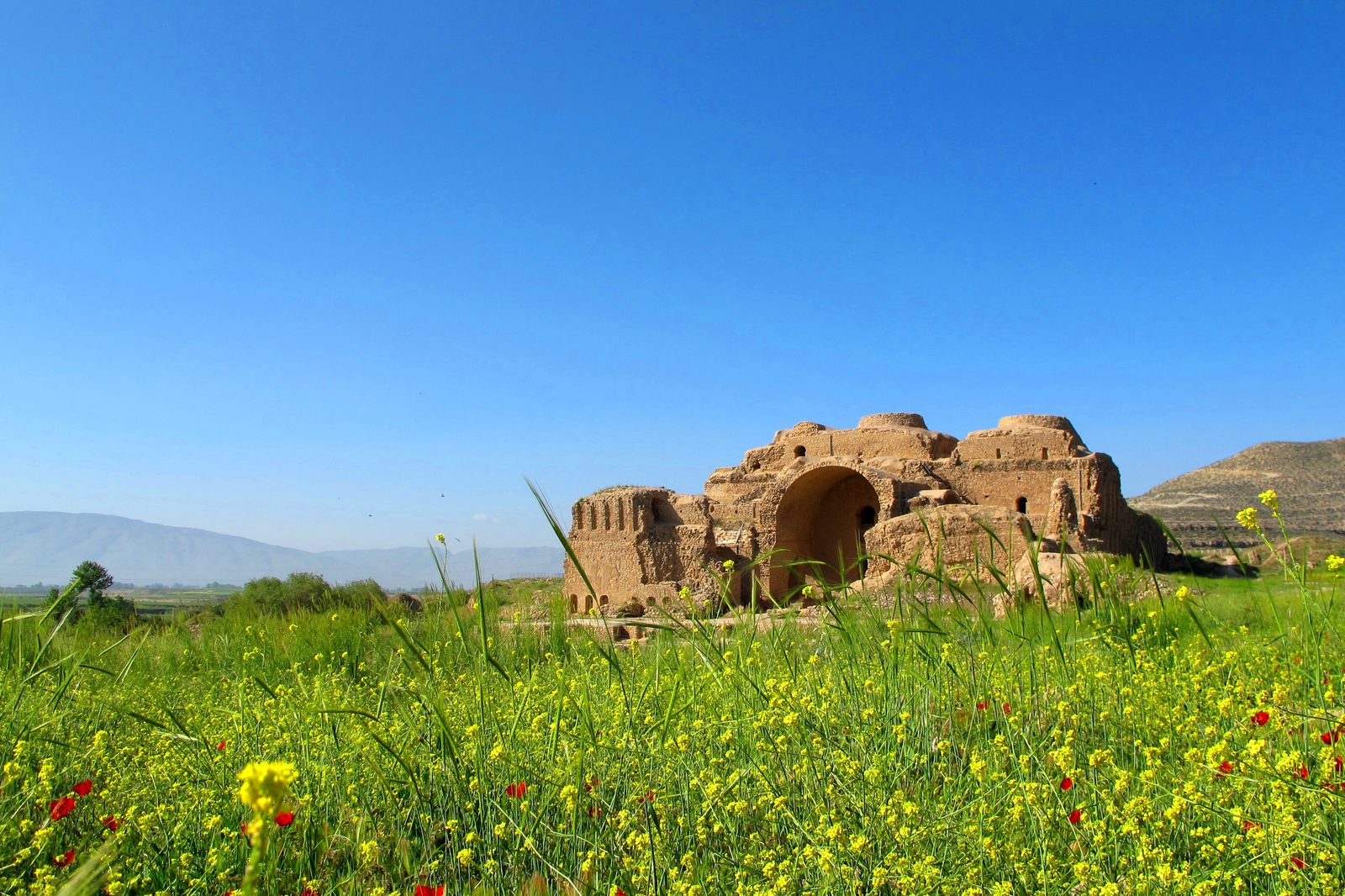
UNESCO 2018Ardashir I's grand ceremonial palace beside a spring-fed pool, famous for its domes on squinches. Built c. 224 CE, it is one of the earliest surviving examples of domes raised on squinches over a square chamber and three large iwans—an engineering leap that influenced later Persian and Islamic dome architecture. Designed to display royal majesty rather than for defense, set beside a sacred spring possibly linked to the goddess Anahita.
- Where
- ~2 km north of ancient Gor, Tang-ab area
- Time needed
- 1–1.5 hours
- Opening hours
- Verify opening hours and ticket price before travel; bring water, little shade on site.
- 2
Qal'eh Dokhtar (Maiden Castle)
UNESCO 2018Ardashir's earlier cliff-top fortress-palace commanding the Tang-ab gorge. Built c. 209–224 CE on a rocky bluff above the river and road, it combines defense with palatial design—an arched vault, a domed hall on squinches, and a spiral staircase. It marks an early step in Sassanid dome construction and offers sweeping views over the gorge and plain. Structurally fragile and slowly eroding.
- Where
- Tang-ab gorge, beside the Firuzabad–Kavar road
- Time needed
- 1–1.5 hours
- Opening hours
- Steep, uneven climb; wear good footwear. Verify access and any closure for conservation before travel.
- 3
Ardashir-Khurreh / City of Gor (circular city)
UNESCO 2018Ruins of the world's first known perfectly circular planned city, ~2 km in diameter. Ardashir I's capital was laid out as a near-perfect circle (~1,950 m diameter) divided into 20 radial sectors by a precise geometric grid, ringed by a moat and wall. The radial plan is best appreciated from height or aerial imagery and is a landmark in the history of urban planning.
- Where
- NW of modern Firuzabad
- Time needed
- 1–2 hours (combine with the central tower)
- Opening hours
- An open archaeological plain rather than a ticketed building; circle plan is clearest from elevated viewpoints. Verify any guided-access requirements.
- 4
Minar / Terbal (central tower of Gor)
UNESCO 2018Tall stone spiral tower at the exact center of the circular city. A roughly 9 m square stone pier rising over 30 m, built by Ardashir I as the symbolic and geometric heart of his circular capital—variously interpreted as a spiral fire/observation tower marking the city's axis. One of the most enigmatic Sassanid structures.
- Where
- Center of Ardashir-Khurreh / Gor
- Time needed
- 30–45 minutes
- Opening hours
- Open ruin on the plain; no facilities. Verify access route before travel.
- 5
Victory Relief of Ardashir I (Tang-ab)
UNESCO 2018Monumental rock relief of Ardashir's cavalry victory over the last Parthian king. Carved on a vertical cliff on the bank of the river in the Tang-ab gorge, this equestrian battle scene commemorates Ardashir's 224 CE defeat of Artabanus and is often cited as the largest surviving Iranian rock relief (about 18 m long). Foundational Sassanid royal propaganda imagery.
- Where
- Tang-ab gorge, near Qal'eh Dokhtar
- Time needed
- 30–45 minutes
- Opening hours
- Roadside/riverside relief; verify exact pull-off and footpath before travel. Best light in morning.
- 6
Investiture Relief of Ardashir I (Tang-ab)
UNESCO 2018Rock relief showing the god Ahura Mazda handing Ardashir the ring of kingship. Depicts Ohrmazd (Ahura Mazda) investing Ardashir with the diadem/ring of sovereignty, with the defeated foes trampled underfoot—a defining image of Sassanid divine-right kingship and one of five reliefs Ardashir commissioned during his reign.
- Where
- Tang-ab gorge, walking distance from Qal'eh Dokhtar
- Time needed
- 30 minutes
- Opening hours
- Open-air relief on the gorge wall; verify path and parking before travel.
- 7
Tang-ab gorge & Sassanid bridge ruins
Scenic river gorge linking the monuments, with remains of a defensive wall and ancient bridge. The dramatic gorge north of Qal'eh Dokhtar was the strategic gateway to the circular capital; it holds the two royal reliefs, a blocking defensive wall, and the ruins of a Sassanid bridge. The water, cliffs, and ruins make it the natural-and-historical spine of any Firuzabad visit.
- Where
- Between modern Firuzabad and the monuments
- Time needed
- 1 hour (combine with reliefs/castle)
- Opening hours
- Open landscape; conditions vary with season and river flow. Verify road conditions before travel.
- 8
Qashqai nomad encampments (seasonal)
Winter pastures of the Qashqai tribal confederacy on the Firuzabad plain. Firuzabad and the surrounding Fars plains are traditional winter grazing grounds of the Qashqai, a Turkic-speaking nomadic confederacy renowned for gabbeh/kilim weaving, music, and pastoral life. In the cooler months visitors can arrange to meet families, see weaving and bread-making, and witness a living continuity with the region's deep past.
- Where
- Surrounding Firuzabad plain (seasonal, roughly Oct–Apr)
- Time needed
- Half to full day with a guide
- Opening hours
- Seasonal and location-dependent; arrange respectfully through a local guide/operator. Verify timing of the migration before travel.